Service
Shockwave therapy in Falkirk
An evidence-based option for certain stubborn, longer-standing problems, such as tendon pain that hasn't responded to other treatment. Shockwave delivers focused energy to the affected area, designed to support the body's natural healing response. We'll assess whether it's right for you before we recommend it.
At a glance
For stubborn problems
An option for longer-standing tendon pain.
Focused energy
Supports the body's natural healing response.
Assessed first
We check it is right for you before recommending it.
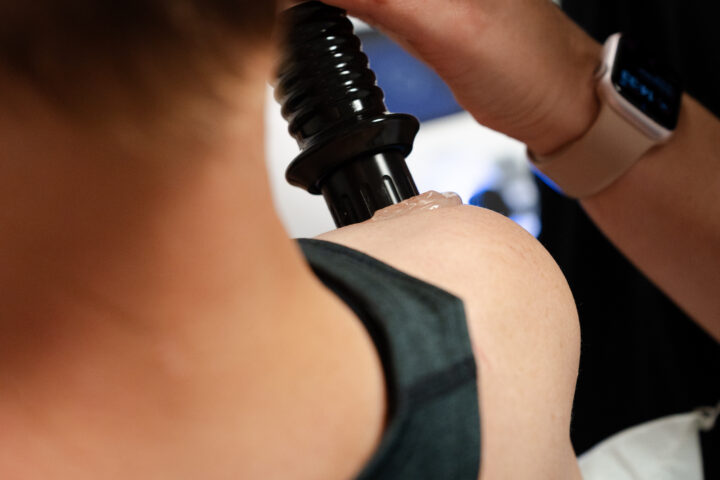
Shockwave therapy is a non-invasive treatment that uses high-energy acoustic pulses to stimulate the body’s natural healing response in areas of chronic pain or stubborn injury. It has a good evidence base for chronic tendon problems, and we use it most often for conditions that have not settled with rest, manual therapy or exercise alone.
The targeted pulses work by increasing blood flow to the affected area (neovascularisation), breaking down calcific build-up, and stimulating the repair of damaged tissue, helping to kick-start healing in cases where the body’s own recovery process has stalled.
Shockwave is most commonly used for chronic tendinopathies and persistent musculoskeletal conditions, including:
- Plantar fasciitis
- Achilles tendinopathy
- Tennis and golfer's elbow
- Shoulder tendinopathy (including calcific tendinitis)
- Patellar tendinopathy (jumper's knee)
- Other stubborn, long-standing soft tissue injuries
Treatment is quick, typically taking just a few minutes per session. Shockwave is often used alongside physiotherapy and manual therapy as part of a wider treatment plan, and is available for a £15 supplement per session.
Evidence recommends between 3 to 5 treatment sessions spaced around 1 week apart to get the most effective response.
Evidence and further reading
The National Institute for Health and Care Excellence has published interventional procedures guidance on extracorporeal shockwave therapy, including Achilles tendinopathy (IPG571) and refractory plantar fasciitis (IPG311). Evidence varies by condition, which is why we assess first and will tell you honestly if we do not think shockwave is the right option for you.
When it may not be suitable
- Pregnancy
- Active cancer, or treatment near a tumour site
- Blood clotting disorders or use of anticoagulant medication
- Local infection at the treatment site
- Treatment directly over major nerves, blood vessels, or the lungs
- Steroid injection in the treatment area within the previous 4 to 6 weeks
- Acute inflammation or acute injury (in the very early stages)
- Growth plate involvement in children or adolescents (open epiphysis)
- Pacemakers (treatment near the device)
- Untreated joint or bone infections
- Impaired sensation or nerve damage in the treatment area
This page is general information, not personal medical advice. Read our medical disclaimer.